STEELAGE BLOGS
Thu 1st October 2026
Locker, Cabinet or Safe? What Actually Protects Your Valuables at Home
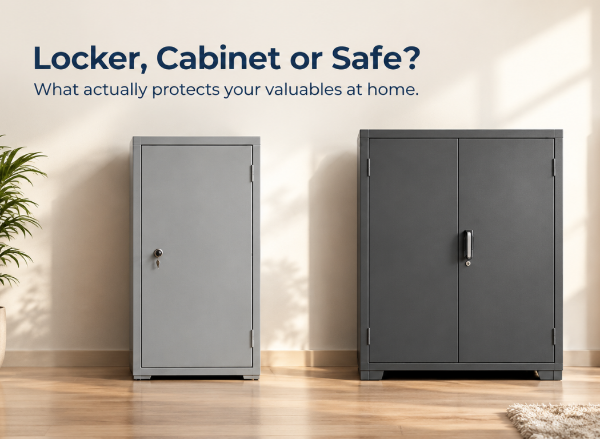
Walk into most Indian homes and the gold is sitting in a bedroom almirah behind a lock that a determined person could defeat with a screwdriver and a few minutes of privacy. Everyone knows this. It is why so many households have upgraded.
Now walk into the homes that have upgraded. Very often you will find something that looks far more reassuring: a compact steel box tucked into the wardrobe, with a fingerprint scanner on the front. It has a keypad. It beeps. It has a brand name and a warranty card. It feels like security.
Most of the time, it is not.
The Indian market sells three quite different products under a blur of overlapping names lockers, secure cabinets and safes and only one of them is engineered to survive an attack. The other two are storage. Often very good storage: tidy, lockable, useful. But storage.
This guide is about that one distinction, because it decides whether your purchase protects your gold or merely organizes it.
Storage Is Not Security
The question most buyers ask is "which safe should I buy?" The better first question is "is this actually a safe?"
A storage product is designed around access control. It answers one question: who is allowed to open this? A key, a combination, a PIN, a fingerprint. Once that question is answered, the product's job is done.
A security product is designed around attack resistance. It answers a different question entirely: what happens when somebody who cannot open it tries anyway with a crowbar, a hammer drill, an angle grinder or a gas torch? That is a materials and construction problem, and no lock, however sophisticated, solves it.
This matters because burglars almost never pick locks. Picking is slow, skilled and unnecessary. They attack the body, the seam where the door meets the frame, and the hinges, because that is faster and needs no skill at all. A thin sheet-metal box will yield to a pry bar at the door edge in well under a minute and the fingerprint scanner will still be working perfectly, sitting on a door that has been bent away from the body.
Everything else in this guide follows from that one idea: you are not buying a lock. You are buying a wall.
What Actually Makes a Safe a Safe
Here is the structural definition.
A safe has two steel walls an outer body and an inner body with a filled gap between them.
That gap is the whole point. It is not empty, and it is not merely insulation. It holds barrier material: a dense engineered reinforcement, formulated specifically to be hostile to tools and torch attacks
That barrier material does distinct jobs:
-
Tool Resistance – Resistance to attacks against modern day tools
-
Torch Resistance – Resistance to torch attacks
-
Fire resistance – Offers protection against fire
A single-walled box has none of this. However thick and solid the door looks from the front, if there is nothing between the two skins, it is an enclosure, not a barrier.
This also gives you the fastest possible filter on a showroom floor. Ask one question: is the body double-walled, and what is between the walls?
Beyond the walls
A properly engineered safe also gets this right, and they are worth checking:
-
Locking bolts on more than one side. The door should throw bolts into the frame on the lock side and be captured on the hinge side, so that knocking the hinges off does not remove the door.
-
A pry resistant door system. The door seats into a recess in the body rather than sitting flat against it. Engineered to resist forced opening attempts.
-
A welded, multi-bend body. The body is formed and welded rather than screwed or riveted together, so that pull force on the door is resisted by the body itself, not by fasteners that will strip.
-
A relocking device. Automatically deadlocks the door in the event Of lock tampering
Locker, Secure Cabinet, Safe: What Each One Is Honestly For
These three words get used interchangeably by sellers and buyers alike. They should not be.
|
Locker |
Secure Cabinet |
Safe |
|
|
Construction |
Single wall, sheet metal |
Single wall, sheet metal, shelved |
Double wall with barrier material |
|
Designed to resist |
Casual access |
Casual access |
Prying, drilling, cutting; torch in higher grades |
|
Typical weight |
Light, liftable |
Heavy but hollow |
Heavy for its size, and deliberately so |
|
Certification |
Usually none |
Usually none |
BIS / ISI mark under IS 550 |
|
Right for |
Daily-wear jewellery, spare cash, keys, documents you handle often |
Files, records, bulk paperwork, organised household storage |
Gold, cash reserves, property documents, anything whose loss you could not absorb |
|
Wrong for |
Your gold |
Your gold |
Nothing |
The mistake is never buying a locker. The mistake is buying a locker and believing it is a safe and then putting forty lakhs of gold inside it.
In practice, a well-set-up household often owns two things: a cabinet for volume, and a safe for value. They are solving different problems and there is no reason to make one product do both jobs.
BIS Certification: The Only Claim That Has Been Tested
Everything described so far is something a manufacturer can simply say. "Double-walled." "Burglar-proof." "High security." "Solid steel construction." Nobody is stopping them, and on a product, you will never cut open, you have no way to check.
This is what BIS certification is for. It is the difference between a claim and a tested result.
In India, safes are covered by IS 550, the Indian Standard issued by the Bureau of Indian Standards, and it comes in three parts:
-
IS 550 (Part 1) — Specification. Covers dimensions, materials, construction and performance requirements. This is the part that lays down things like multi-bend body construction, a rebate on all four sides, and the requirement that pull force on the door be resisted by an integral or welded part of the body rather than by components that are merely screwed or riveted on.
-
IS 550 (Part 2) — Tests for Burglary Resistance. The safe is physically attacked under controlled laboratory conditions, with a defined tool set, for a defined working time.
-
IS 550 (Part 3) — Tests for Fire Resistance. The safe is placed in a furnace and heated to a defined curve while the temperature inside is monitored.
A safe carrying the ISI mark under IS 550 has been through that. A safe without certification may well be excellently built but you have no evidence, and in most cases neither does the person selling it to you.
FAQ’s
-
Is this specific model BIS certified under IS 550? Note the wording. Certification attaches to models, not to companies. "Our company is BIS certified" is not an answer to this question.
-
What is the classification code? Certified safes are designated by a class, which tells you the level of resistance they were tested to. Ask what class this model holds and what that class means.
-
Can I see the CM/L number for this model? A manufacturer who holds one can show you the CM/L number for the product model.
If nobody can produce a document, treat the safe as uncertified and price it accordingly in your own mind.
Established Indian manufacturers Steelage among them manufacture BIS-certified physical security products, so it is worth asking for required certification details for a given model rather than assuming the brand name settles it.
Where to Put It, and Why Anchoring Is Not Optional
An unanchored safe is a portable safe
This deserves stating bluntly, because it undoes everything else you have paid for. A safe that is not bolted down can be picked up and taken away, and then the burglar has unlimited time, a workshop and no reason to be quiet.
Anchoring is not an optional accessory. It is the last step of the product working as designed.
Choosing the location
-
Prefer ground-floor built-in storage, a utility area, or under-stair space somewhere unremarkable.
-
Stay away from exterior walls and windows, which give an intruder both privacy and an exit.
-
Avoid damp. Bathroom-adjacent walls, areas that flood in monsoon, and poorly ventilated corners will corrode hinges and bolt work over years.
-
Stay reachable. Concealed is good; sealed behind furniture you cannot move in an emergency is not. You may need documents at short notice.
Installing it properly
-
Choose a solid, load-bearing surface that can carry the weight structural concrete floor or wall, not a partition, not tile over screed alone.
-
Mark the anchor points using the manufacturer's template.
-
Drill to the recommended bit size and depth, into structural concrete. Anchoring into plaster, hollow block or tile alone is the same as not anchoring.
-
Fix using the anchor bolts supplied with the safe, through the designated anchoring holes only.
-
Cycle the door several times, opening and closing and throwing the bolts, to confirm nothing has shifted or racked during installation.
Use the manufacturer's technical team or an authorised installer.
Home Safe or Bank Locker?
This is the question most households circle back to, and the honest answer is that they solve different problems.
|
Home Safe |
Bank Locker |
|
|
Access |
Any time, including nights and holidays |
Bank working hours only |
|
Convenience |
Immediate, at home |
Requires a branch visit, often with notice |
|
Cost |
One-time purchase, plus installation |
Annual rent, indefinitely |
|
Emergency access |
Instant |
Delayed by hours or days |
|
Liability if contents are lost |
Yours entirely |
Limited |
|
|
|
|
|
Best for |
Jewellery in regular use, documents you need at short notice |
Heirlooms and holdings you genuinely do not touch for years |
Buying Checklist
-
☐ Decide what you are storing value items, bulk documents, or both
-
☐ Decide whether you need a safe, a cabinet, or one of each
-
☐ Confirm the body is double-walled with barrier material, and ask what the barrier material is
-
☐ Ask for BIS certification under IS 550 for that specific model, and ask to see the licence
-
☐ Check the classification code and what level of resistance it represents
-
☐ Confirm a fire rating if you are storing documents
-
☐ Choose the lock type last: key, pin based or biometric, with a working override
-
☐ Confirm it is designed to be anchored, and that anchor points and bolts are supplied
-
☐ Plan the installation location before delivery day
-
☐ Book professional installation