STEELAGE BLOGS
Wed 7th October 2026
Bank Locker or Home Safe? What to Know Before Renting a Bank Locker
Bank Locker: Everything You Should Know Before Renting One
For generations, the bank locker has been the default answer to “where do I keep my gold safe?” in Indian households. But is it still the right choice for everyone, and how does it actually compare to keeping a safe at home? This guide breaks down how bank lockers work, what they’re good for, and where they fall short.
What Is a Bank Locker?
A locker in a bank is a secure, individually lockable steel compartment housed within a bank’s vault, rented out to customers to store valuables - jewellery, documents, cash, or other small high-value items. Lockers in banks are typically organised in a bank of lockers - rows of individually numbered, lockable boxes inside a reinforced vault room.
Access requires visiting the branch, verifying identity, and in most systems, using two keys together - one held by the customer and one by the bank - to open the individual locker.
How Does a Bank Locker System Work?
A bank locker system generally works like this:
- You rent a locker of a chosen size at a branch, usually with an annual fee.
- The bank issues you a key or access credential to your specific safe deposit locker.
- To access it, you visit the branch during banking hours, verify your identity, and the locker is opened jointly - often with your key and a bank-held master key or through a dual-authentication process.
- You place or remove items in a private access area, then the locker is resealed.
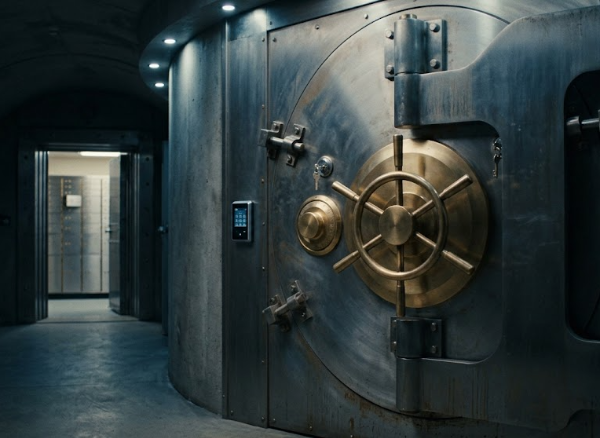
- The entire bank locker vault - the room housing all individual lockers - is itself secured with reinforced construction and a vault door, similar in principle to a strong room.
What Can Be Stored in a Bank Locker?
Common items stored in bank lockers include gold and jewellery, property documents, insurance papers, fixed deposit receipts, wills, and sometimes cash - though banks often place restrictions or discourage storing large amounts of cash, and typically don’t permit hazardous, illegal, or perishable items.
Are Bank Lockers Safe?
This is one of the most frequently asked questions, and the honest answer is nuanced. Bank lockers are generally considered a secure storage option because they sit inside a reinforced bank locker vault, protected by the bank’s overall security infrastructure - CCTV, guards, alarm systems, and structural security.
However, is bank locker safe in an absolute sense depends on understanding what the bank actually guarantees. Historically, the contents of a bank locker were not automatically insured by the bank, and liability in cases of theft, fire, or other loss has been a subject of debate and evolving regulation. Because banking rules and policies around locker liability can change and vary by bank, it’s important to check the current, specific terms and conditions directly with your bank rather than relying on general assumptions.
| Factor | Bank Locker | Home Safe |
|---|---|---|
| Access Hours | Limited to banking hours | 24/7 |
| Convenience | Requires travel to branch | Immediate, at home |
| Recurring Cost | Annual rental fee | One-time purchase cost |
| Contents Insurance | Often not automatically covered — verify with your bank | Not automatically insured either — separate insurance can be arranged |
| Security Infrastructure | Backed by full bank vault and security systems | Depends entirely on the safe and its installation |
| Best Suited For | Items accessed rarely | Items needed frequently, or as a supplement to a bank locker |
Access hours Limited to banking hours 24/7 Convenience Requires travel to branch Immediate, at home Recurring cost Annual rental fee One-time purchase cost Contents insurance Often not automatically covered — verify with your bank Not automatically insured either — separate insurance can be arranged Security infrastructure Backed by full bank vault and security systems Depends entirely on the safe and its installation Best suited for Items accessed rarely Items needed frequently, or as a supplement to a bank locker
Safe Custody vs Locker
Safe custody vs locker is another common point of confusion. In a locker arrangement, you retain the key and direct control over what’s placed inside - the bank generally doesn’t know or handle the specific contents. In a safe custody arrangement, you typically hand over a sealed packet or envelope to the bank, and the bank holds it in custody without you having direct, independent access the way you would with your own locker key. The exact terms, access process, and liability differ by bank, so it’s worth confirming details with your specific branch.
Bank Locker Dimensions and Sizes
Bank lockers typically come in a range of sizes - often described as small, medium, large, and extra-large - to suit different storage needs, from a few jewellery items to bulkier document storage. Bank locker dimensions vary between banks and branches, so it’s best to check directly with your bank for their specific size options and corresponding rental fees.
Bank Locker Vaults and Security
The bank locker vault - sometimes referred to as vaults in banks - is built to the same general security principles as a strong room: reinforced walls, a heavy vault door, and layered access control. Individual lockers sit within this larger secured room, meaning your locker’s security depends both on its own lock and on the vault housing it.
Safe Deposit Lockers
A safe deposit or safety deposit locker is essentially the formal name for what most people simply call a bank locker. The terms safe-deposit and deposit locker are used interchangeably across most Indian banks. For those specifically looking at storage outside of a bank branch, a safe deposit locker for home typically refers to a home safe marketed with similar “safe deposit” language, though it functions as a standalone unit rather than being housed within a bank’s vault infrastructure.
Jewellery Storage Options
Beyond a traditional bank locker, households also consider:
- A home vault safe or jewellery lockers kept at home for frequently accessed items
- A biometric home safe for quicker, keyless access
- A combination approach - high-value or rarely used pieces in a bank locker, everyday jewellery in a home safe
Advantages and Limitations of Bank Lockers
Advantages: - Backed by the bank’s overall security infrastructure - Removes the item from your home entirely, reducing home burglary risk - Generally well-suited for rarely accessed valuables
Limitations: - Access restricted to banking hours - Requires physical travel to the branch every time - Contents typically not automatically insured - verify current terms with your bank - Annual rental cost adds up over time - Limited immediate access during emergencies
Important Things Customers Should Know Before Choosing a Locker
- Confirm your bank’s current policy on liability and insurance coverage for locker contents, since rules can change
- Ask about locker size options and corresponding fees before committing
- Understand the access process - some banks require advance notice or specific hours
- Keep a personal inventory or list of what you’ve stored, since the bank generally won’t know your locker’s contents
- Consider whether a home safe better complements your access needs, particularly for items you use often
| Aspect | Strong Room Door | Vault Door |
|---|---|---|
| Definition | Heavy-duty door designed to secure an entire strong room. | High-security door designed to protect a vault or highly secure storage area. |
| Typical use | Banks, financial institutions, jewellery stores and commercial premises. | High-security vaults, banks, cash centres and specialised storage facilities. |
| Structural dependency | Works as part of a complete strong room structure with reinforced walls, ceiling and floor. | Can be installed as the access point to a dedicated vault or high-security enclosure. |
| Size range | Generally available in larger sizes to provide access to an entire secure room. | Available in different sizes depending on the vault design and security requirements. |
| Feature | Strong Room Door | Vault Door | Safe Door |
|---|---|---|---|
| Scale | Large-scale security solution for an entire strong room. | Large, high-security door for vaults and secure areas. | Compact door integrated into a safe or security cabinet. |
| Structural dependency | Requires a properly constructed strong room. | Typically forms part of a dedicated vault structure. | Does not require a separate room structure. |
| Typical buyer | Banks, jewellery stores and financial institutions. | Banks, cash centres and high-security facilities. | Homes, offices, jewellery retailers and businesses. |
| Locking complexity | May use advanced multi-point and time-locking systems. | Often incorporates advanced high-security locking mechanisms. | May use key, combination, electronic or biometric locking systems. |
| Price range | Generally higher due to size, construction and installation requirements. | Generally high due to specialised construction and security features. | Varies based on size, material, locking system and security level. |
| Installation | Requires professional installation as part of the strong room. | Requires specialised installation and structural integration. | Usually installed as part of the safe and may require anchoring. |
FAQs
What is a locker in a bank? A bank locker is an individually lockable steel compartment inside a bank’s secure vault, rented to customers for storing valuables like jewellery, documents, and other high-value items.
Are bank lockers safe? Bank lockers are generally considered secure since they’re housed within a reinforced bank vault with layered security. However, contents are often not automatically insured by the bank, so it’s important to confirm current liability and insurance terms directly with your bank.
What is a safe deposit locker? A safe deposit locker (also called a safety deposit locker) is another name for a standard bank locker - a rented, secure compartment within a bank’s vault used to store valuables and documents.
What is the difference between safe custody and a locker? With a locker, you hold a key and have direct, independent access to your own compartment. With safe custody, you typically hand over a sealed item to the bank for safekeeping, without the same direct access arrangement. Exact processes vary by bank.
Is a home safe better than a bank locker? Neither is universally “better” - a home safe offers 24/7 access and no recurring rental fee, while a bank locker offers the backing of a bank’s full vault security infrastructure. Many households use both: a bank locker for rarely accessed valuables, and a home safe for items they need more regularly.
vault door, strong room doors manufacturer)
H1: Strong Room Doors Explained: How Vault Doors Protect Banks, Jewellers and Institutions
Strong Room Doors: A Complete Guide to Vault Doors and Bank Security
When a bank, jeweller, or large institution needs to secure high-value assets, an ordinary safe isn’t enough - that’s where strong room doors and vault doors come in. These are engineered security systems, not off-the-shelf products, and choosing the right one involves understanding construction, certification, and installation requirements specific to your facility.
This guide covers what strong room doors and vault doors are, how they differ, what goes into them, and what to evaluate when working with a strong room doors manufacturer or supplier.
What Is a Strong Room?
A strong room is a physically reinforced room - walls, ceiling, floor, and door all built to a high security specification - used to store cash, bullion, valuables, or sensitive records. Unlike a safe, which is a standalone unit, a strong room is structural: it’s part of the building itself, typically built with reinforced concrete and steel-lined surfaces.
Banks, jewellers, government treasuries, and large corporates use strong rooms when the volume or value of what they’re storing exceeds what a safe or vault door alone can practically hold.
What Is a Vault Door?
A vault door is the heavy, engineered door that seals the entrance to a strong room or bank vault. It’s the single most critical security component of the room, since walls and ceilings are typically strong enough on their own - the door is usually the weakest point in any secure enclosure, which is why vault doors receive so much engineering attention.
A bank vault door is built from thick layers of steel (sometimes composite steel and concrete), fitted with a heavy-duty locking mechanism, and mounted on reinforced hinges designed to prevent forced removal.
Difference Between a Strong Room Door and a Vault Door
In practice, the terms are often used interchangeably, but there’s a technical distinction worth knowing:
|
Aspect |
Strong Room Door |
Vault Door |
|
Definition |
The door specifically built into a strong room structure |
A broader term for any heavy security door, including standalone vault installations |
|
Typical use |
Banks, treasuries, large institutional storage |
Banks, but also large jewellers, data centres, private high-security rooms |
|
Structural dependency |
Always paired with a reinforced room |
Can sometimes be part of a smaller, dedicated vault enclosure |
|
Size range |
Generally large, built for room-scale access |
Ranges from large bank doors to smaller vault-scale doors |
Key Parts of a Vault Door
At a high level, a vault door assembly typically includes:
- Door slab - the thick steel (or steel-composite) body that forms the physical barrier
- Frame - anchored into the surrounding structure, distributing forces evenly
- Locking bolts - multiple bolts extending into the frame on several sides, not just one
- Lock mechanism - a combination, key, electronic, or hybrid locking system
- Hinges - reinforced, often concealed or protected against tampering
- Time-delay or dual-control features - used in many commercial and banking installations to prevent single-person access
We won’t go into the specific mechanics of how these components can be defeated or bypassed - that information isn’t something we’ll cover here, for obvious security reasons.
How Does a Vault Door Work?
At a conceptual level, a vault door works by combining three things: mass (thick steel is hard to cut or blast through quickly), multi-point locking (bolts on multiple sides resist prying, since force applied to one side doesn’t unseat the whole door), and anchoring (the frame is embedded into the surrounding structure so the door can’t simply be pulled out).
Modern vault doors often add electronic or dual-control locking, time delays, and audit logging, but the underlying physical security principle - mass, multi-point locking, and structural anchoring - hasn’t fundamentally changed.
Types of Strong Room Doors
- Single-leaf vault doors - one solid door panel, common in smaller installations
- Double-leaf vault doors - two panels, used for wider openings
- Modular vault doors - designed to be assembled and installed without extensive structural rework, useful for retrofits
- Time-lock vault doors - incorporate mechanical or electronic time delays before opening
Steel Vault Doors
Steel vault doors remain the industry standard because steel offers a strong combination of hardness, weldability, and cost-effectiveness compared to other materials. The steel is typically layered - sometimes combined with composite fill materials - to balance weight, cost, and resistance to cutting, drilling, and blast forces.
High-Security Vault Doors
A high security vault door typically goes beyond basic thickness and adds:
- Independently tested and certified resistance ratings
- Advanced multi-point locking (often 6+ bolt points)
- Anti-drill and anti-cut plating at critical points
- Electronic access control layered with mechanical locks
- Audit trails for access logging
Bank Vault Doors and Security Requirements
Bank vault doors and bank safe doors are typically subject to institutional and, in many cases, regulatory security requirements that go beyond what a private strong room needs - including specific certification, dual-control access procedures, and integration with the bank’s broader security and surveillance systems. Requirements vary by institution and jurisdiction, so banks typically work directly with their security vendor and compliance team on exact specifications.
Modular Vaults and Modular Security Vaults
A modular vault or modular security vault is pre-engineered in sections and assembled on-site, rather than being built entirely from scratch with in-situ construction. This approach is useful when:
- A building wasn’t originally designed with a strong room in mind
- Installation time needs to be minimised
- The vault may need to be relocated or reconfigured in future
Modular systems can achieve security levels comparable to traditional built-in-place strong rooms, provided the modular panels and door are properly rated and correctly installed.
Strong Room Design Considerations
- Structural load - the room and surrounding structure must support the weight of reinforced walls, floor, and door
- Access control - number of authorised personnel, dual-control requirements
- Ventilation - sealed rooms need proper airflow planning, especially if occupied briefly during access
- Fire protection - often integrated alongside physical security
- Surveillance integration - CCTV, alarms, and access logging tied into the room’s design
Strong Room Construction Details
Strong room construction details typically involve reinforced concrete walls (often with embedded steel mesh or plating), a reinforced floor and ceiling, and the vault door as the primary access point. Construction is usually managed jointly between a structural engineer or contractor and the security vendor supplying the door and vault-lining systems, since the room and the door need to work together as a single, coherent security system.
Vault Door Locks and Security Mechanisms
Vault door locking systems generally fall into a few categories: mechanical combination locks, key locks, electronic/digital locks, and increasingly, hybrid systems combining more than one method along with time-delay features. The right choice depends on the institution’s operational needs, staffing, and compliance requirements - a decision best made with a qualified security vendor.
Factors Affecting Vault Door Price
Vault door price depends on several variables:
- Size and thickness of the steel door slab
- Security rating/certification level
- Locking mechanism complexity (mechanical vs electronic vs hybrid)
- Number of locking bolt points
- Custom features - time delays, dual control, remote monitoring integration
- Installation complexity, including structural reinforcement needed at the site
Given the engineering and customisation involved, vault door pricing is typically quoted per project after a site assessment, rather than as a fixed catalogue price.
Installation and Maintenance
Vault door installation is a specialised job - it requires structural assessment, precise frame anchoring, and calibration of the locking mechanism, and is not something handled outside professional installation. Ongoing maintenance typically includes periodic lock servicing, hinge lubrication, and inspection of seals and bolts to ensure the mechanism continues operating within its rated tolerances.
How to Choose a Strong Room Door Supplier or Manufacturer
When evaluating a strong room doors manufacturer or strong room doors suppliers, consider:
- Track record and years of experience in institutional security
- Independent testing and certification of their products
- Ability to customise for your specific structural constraints
- After-sales service and maintenance support
- References from existing bank or institutional clients
Established Indian manufacturers such as Steelage, which produces vault doors and strong room security systems among its broader security equipment range, are worth including in your supplier evaluation alongside other reputable vendors - comparing certifications, project experience, and support terms across a few suppliers is the best way to make an informed decision.
Comparison Table: Strong Room Door vs Vault Door vs Safe Door
|
Feature |
Strong Room Door |
Vault Door |
Safe Door |
|
Scale |
Room-sized entrance |
Vault or room-sized entrance |
Individual safe unit |
|
Structural dependency |
Built into reinforced room structure |
Often paired with reinforced enclosure |
Standalone, self-contained |
|
Typical buyer |
Banks, treasuries, large institutions |
Banks, large jewellers, institutions |
Homes, offices, retail |
|
Locking complexity |
Very high, often multi-control |
High |
Low to moderate |
|
Price range |
Highest, project-quoted |
High, project-quoted |
Lower, catalogue-priced |
|
Installation |
Specialised, structural-level |
Specialised |
Standard installation |
FAQs
How does a vault door work? A vault door works by combining thick, hard-to-cut steel construction, multiple locking bolts anchored into the frame on several sides, and structural anchoring into the surrounding walls - together making forced or rapid entry extremely difficult.
How heavy is a bank vault door? Bank vault doors are typically very heavy, often ranging from several hundred kilograms to multiple tonnes, depending on size, steel thickness, and security rating. Exact weight varies significantly by manufacturer and model.
What are the parts of a vault door? The main parts include the door slab (steel body), the frame, multi-point locking bolts, the lock mechanism, reinforced hinges, and often time-delay or dual-control access features.
How much does a vault door cost? Vault door pricing depends on size, steel thickness, certification level, locking complexity, and installation requirements. Because these are typically custom, project-specific installations, pricing is usually quoted after a site assessment rather than listed as a fixed catalogue price.
What should I look for in a strong room door supplier? Look for a manufacturer with institutional experience, independently certified products, the ability to customise for your building’s structural constraints, and strong after-sales maintenance support.